
Do you read? I mean, really read? A 2024 survey by the Reading Agency found that over one-third of UK adults have abandoned reading for pleasure altogether. That’s a pretty worrying statistic for a nation that prides itself on its literacy levels.
But literacy statistics can conceal a more worrying decline in what is generally referred to as functional literacy, or the ability to understand basic sentences or locate a single piece of information from a short text. Some surveys show that around 28% of adults in the United States are functionally illiterate, and the problem is on the rise. Other developed nations don’t fare much better. In the UK, the National Literacy Trust found that 18% of adults have very poor literacy skills.
One-third of UK adults no longer read for pleasure
28% of adults in the United States are functionally illiterate, while 18% of UK adults have very poor literacy skills.
If effective learning is partly about deep processing (in the language of cognitive psychology, at least), then to become effective readers, we should read often and deeply. In other words, we should be engaging in deep reading.
What is Deep Reading?
Deep reading as a concept refers to the deliberate and immersive practice of engaging with a text to understand its full meaning, context and implications. We can contrast this with other types of reading (such as online reading) that encourage shallow processing by, for example, skimming text in order to identify keywords. Skimming might provide the gist of the text, but often reduces our ability to really understand it.
Deep Reading and Cognitive Processes.
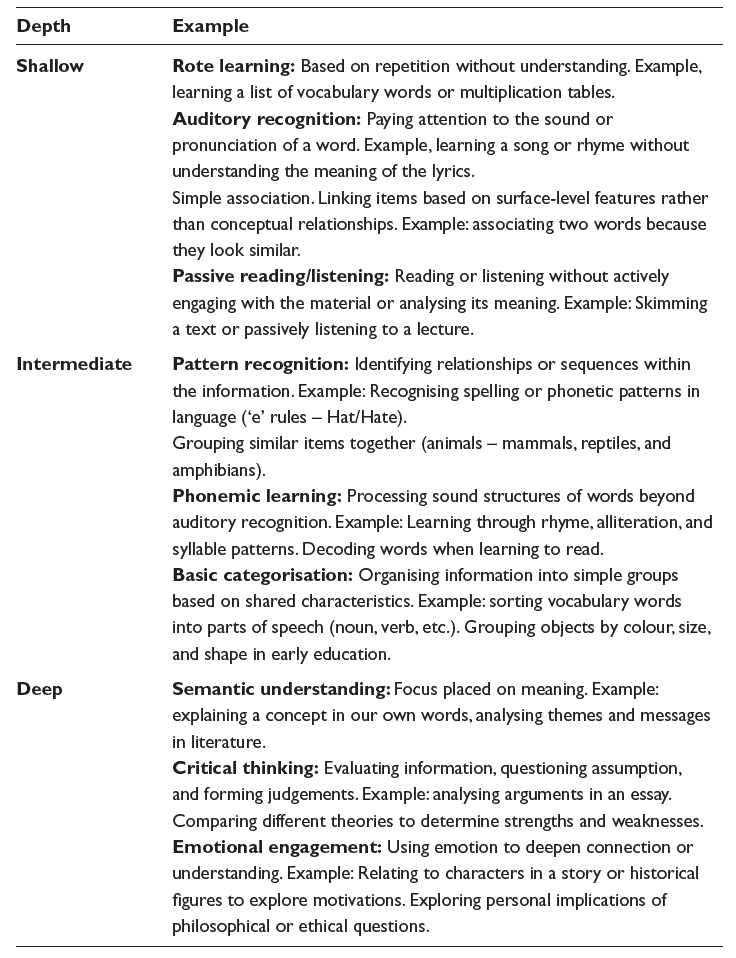
Level of Processing theory suggests that the more we engage with to-be-learned information, the more stable that learning is. We can use methods such as rote memorisation, but this represents shallow learning. Not that rote learning isn’t useful for certain types of material, just that more effective learning requires deeper processing. Meanwhile, elaboration not only results in more effective knowledge generation via consolidation with previously learned information, it also enhances recall.
We live in a world where it’s assumed everyone can read (even if this isn’t always the reality). Reading is crucial to learning. If our reading skills are poor, learning becomes more difficult.
Current educational practices often favour shallow processing over deep processing, particularly when the emphasis is placed on standardised testing. Our memories would much rather snack than gorge (as we can see with the effectiveness of strategies such as spacing and interleaving), but a culture overreliant on testing might inadvertently encourage poor functional literacy.
Below are some examples of learning strategies based on shallow, intermediate and deep processing.
Tips for deeper reading
Before you read.
- Set a purpose
- What is your goal (for example, for relaxation/pleasure, to complete a piece of work such as an assignment, or to learn something new).
Pre-read
- Skim the title, headings, and conclusion. Get a general overview of what you are reading.
- Think about what questions you expect the text to answer. Perhaps jot down some questions.
- Create an environment. Find a quiet, comfortable space free from distractions. Reduce background noise if you can. Keep your phone silent and out of sight.
During your reading
- Slow down. Read at a deliberate pace. Focus on understanding each word and don’t rush. You might find you need to re-read a sentence or paragraph to grasp its contents.
- Focus. Your mind will wander at times. Acknowledge it and re-direct you focus back to the text.
Engage with the text by:
- Annotating, for example, underlining key points, writing notes in the margins, or jotting down questions of general observations.
- Constantly question the text. What is the author’s intention? What point are they attempting to convey? How does it relate to what you already know?
- Imagine the scenes, characters, or concepts. Imagination is a powerful learning tool.
Take breaks.
- Deep reading can be tiring, so take short breaks.
After you read
- At the end of each chapter, summarise the content in your own words.
- Reflect on what you’ve learned, whether your initial questions were answered, and how the content relates to your prior knowledge.
- Find ways to actively use what you’ve read in your work or daily life to solidify your understanding.



 The Emotional Learner
Leave a comment