
We know from decades of research that some learning strategies work much better than others.
The learning sciences often cite three specific strategies that, when applied correctly, can result in huge learning benefits: spaced (or distributed practice), interleaving, and testing (or retrieval practice).
Broadly speaking, these three techniques create what we call desirable difficulties: the appropriate mental effort that drives successful learning.
But difficulty isn’t inherently desirable and, under the wrong conditions, can make things worse.
Interleaving is when we mix (or interleave) distinct but related topics, rather than block them (see this article for a full explanation). This method often leads to slow short-term retention but greater long-term understanding. The former finding often results in educators rejecting the strategy because of the desire to see rapid progress, often within a single lesson.
A problem can arise, however, when the to-be-studied material becomes increasingly complex. Similarly, if learning materials are already too complex, working memory load increases, leading to a potential negative impact on outcomes.
A 2026 study looked specifically at ways to mitigate this increased complexity. To do this, they introduced collaborative learning into the mix to discover if working with others could potentially retain the desirable difficulty element of the task but reduce the negative impact of the increased complexity.
Collaborative learning (or group work) is both hated and loved by teachers (sometimes simultaneously). Like many strategies, it often depends on how teachers implement it and for what reasons. It can, however, help with cognitive overload (see this article on collective working memory), so it would make sense that it could help to lessen the cognitive burden as tasks become increasingly complex.
The researchers recruited 376 upper secondary school pupils and tested them on 4 experimental conditions: interleaved versus blocked practice; collaborative versus individual practice. Knowledge of the material (the motion of charged particles) was then assessed using tests administered immediately after practice and after an 8-week delay.
Results favoured the interleaved-collaborative condition both at the immediate and 8-week stages. Collaboration on its own showed no significant advantage, while interleaving on its own showed no effect immediately after practice and a negative effect after 8 weeks.
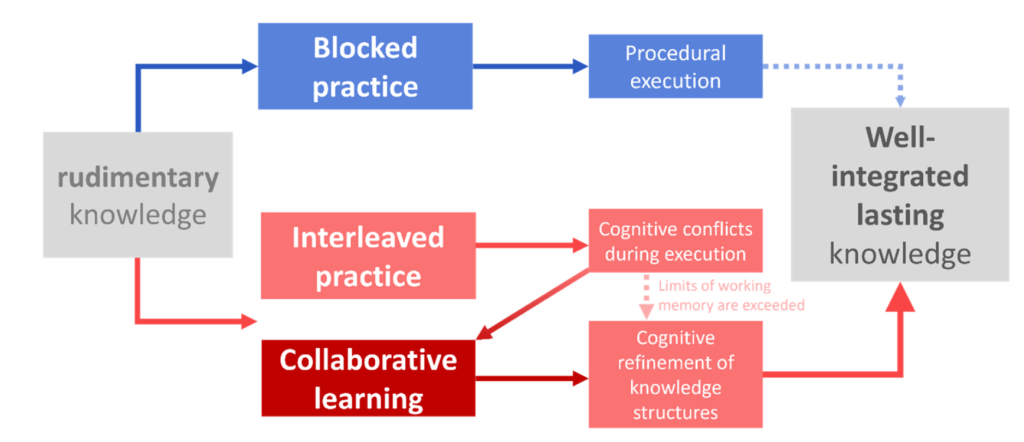
M. Danzglock et al. (2026). Schematic representation of how collaborative learning may support interleaved practice in complex learning contexts.
How can these results inform teaching practice?
The study highlights the difficulty in getting interleaving right. Unless educators consider how the complexity of the topic, as well as the training materials, affects learning outcomes: Too complex and difficulties no longer become desirable; too easy and there is too little cognitive effort applied. We can, however, mitigate the former by combining desirable difficulties (interleaving in this case) with other techniques, such as collaborative learning.
But, as the researchers point out, desirable difficulties are not universally effective; they require instructional support. This support might include techniques that manage cognitive load, such as Load Reduction Instruction, while well-worn pedagogical techniques like collaborative learning may further mitigate load issues.



 The Emotional Learner
Leave a comment