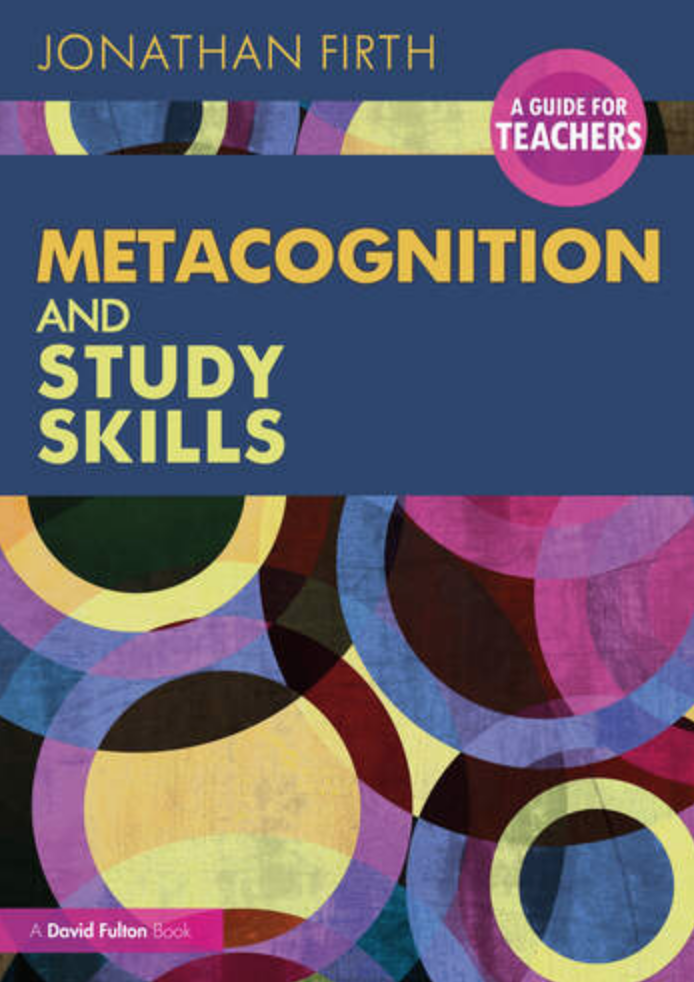
By Jonathan Firth, 2025, Routledge.
Metacognition is a much-misunderstood concept. It’s often poorly defined and haphazardly implemented, yet it underpins all learning because it relates to a person’s understanding of how learning happens, and if we know that, we are much better equipped to learn more effectively.
American developmental psychologist John Flavell describes metacognition as a fuzzy concept of multifarious definitions, so any book that attempts to fix this fuzziness is worth looking at.
In Psychology in the Classroom, my co-author (Jonathan Firth) defines it as any type of thinking about thinking… including thinking about our own memory abilities, or about the process we use when solving a problem, or about our own planning and organisational skills. And this is the approach Jonathan uses in Metacognition and Study Skills (because we can’t exclude study skills from metacognition).
I’ll admit I’m a little biased when it comes to this book. Not only was it an invaluable resource while I was writing the metacognition section of Smarter, but I’m also more than aware of how meticulous Jonathan is about creating usable resources.
With clear evidence-backed precision, Metacognition and Study Skills expertly guides the reader first through the thorny terrain of memory towards a comprehensive conclusion on how to implement metacognitive strategies within a learning environment. Examples, case studies, and tasks reinforce understanding in a very, well, metacognitive way.
Chapters 4 to 6 are particularly useful, describing how to use metacognition before, during, and after a task. The book then focuses on literacy, the role of prior knowledge, and the development of competency.
The book follows a logical progression, from defining terms to building a workable and practical strategy for teachers to use in the classroom. It demystifies metacognition through examples linked to the school environment, rather than becoming weighed down with academic rhetoric and theoretical jargon. Yes, metacognition does have a solid empirical foundation, often based on experiments carried out in artificial environments. But the author takes many of these findings and makes them practical.
If you only read one book on metacognition, I would certainly recommend that it be this one.



 The Emotional Learner
Leave a comment